
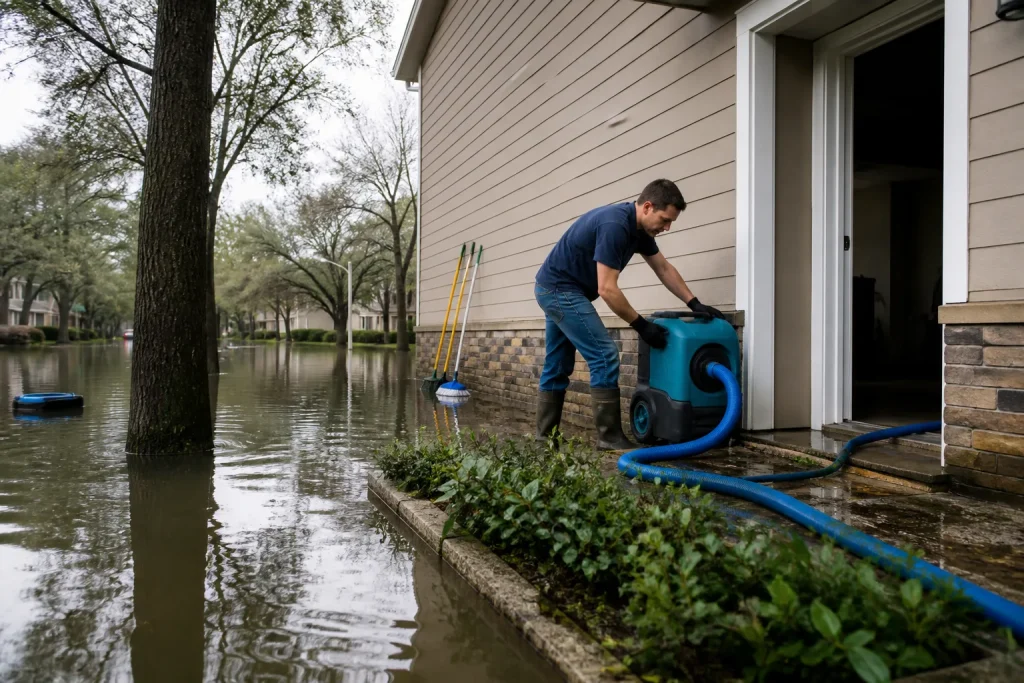
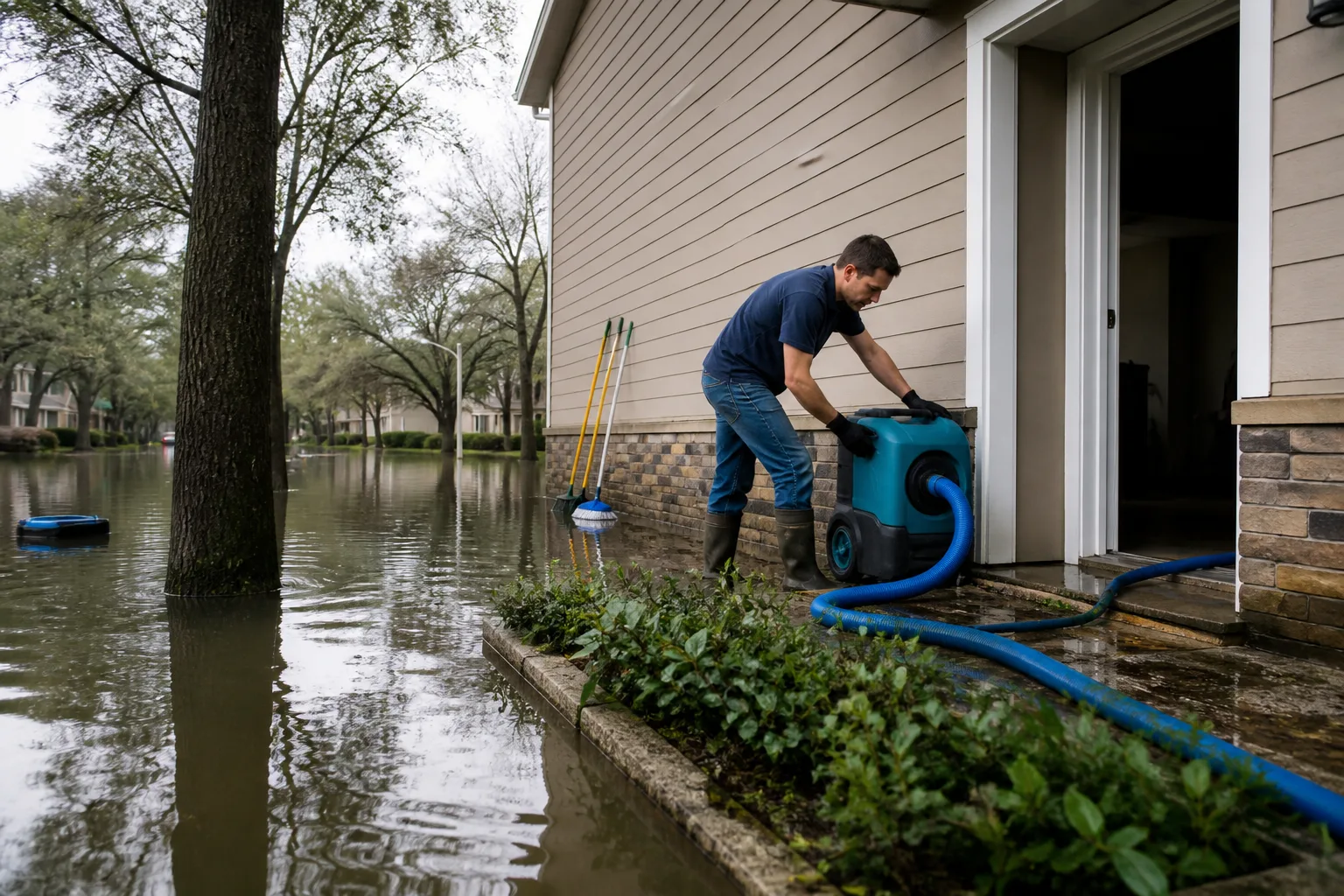
How to Choose the Right Damage Restoration Company in Houston
When water, fire, or mold hits your Houston home, the company you call in the first hour determines whether you’re back to normal in weeks or stuck in limbo for months. The single most important decision is whether to hire a mitigation-only contractor or a full-cycle restoration company that handles extraction, drying, and rebuild under one roof. Split-scope jobs are where scope gets lost, warranties evaporate, and homeowners end up playing project manager. If you’d rather not sort through the fine print yourself, call Floodline Restoration Co. of Houston at (888) 977-4690 and we’ll walk you through it.
Here’s the number that matters: in a split-scope restoration where one company handles water mitigation and another handles the rebuild, the average Houston homeowner makes 26 separate contacts with contractors, adjusters, and suppliers before the job is finished. When a single certified crew owns the project from extraction to punch list, that number drops below ten. That’s the continuity gap, and it’s the most expensive lesson we’ve watched Houston homeowners learn over the past decade and a half.
The Real Cost of Splitting Mitigation from Reconstruction
Most homeowners don’t realize damage restoration is actually two separate trades wearing the same uniform. Mitigation means stopping the damage: extracting water, setting drying equipment, removing wet drywall, treating for mold. Reconstruction means putting the house back: framing, drywall, paint, flooring, trim. Many Houston companies only do the first part. When the drying is done, they hand you an invoice and a list of subcontractors.
What actually gets lost at that handoff is rarely visible to the homeowner. The moisture log that shows which wall cavities were opened and why. The notes on hidden damage discovered behind baseboards. The material selections made during tear-out. The photo documentation that supports your insurance claim. When a rebuild contractor arrives cold, they’re working from someone else’s incomplete picture.
And here’s who bears the cost when scope gaps surface during rebuild: you do. The mitigation company says they dried to standard. The rebuild contractor finds rot in a sill plate. The adjuster says the claim was already closed. You’re left holding the difference. A full-cycle company like Floodline Restoration Co. of Houston home carries that risk internally because the same crew that read the moisture map on day one is the crew that rebuilds the wall. There’s no one to blame but us, and that’s the way we want it.
Five Questions to Ask Before Anyone Sets Foot in Your House
You don’t need to be a restoration expert to vet a company. You need to ask five specific questions and listen carefully to the answers. We’ve put this script together from years of hearing what homeowners wish they’d asked.
1. Are your technicians IICRC-certified, and can you show me the credentials?
The Institute of Inspection, Cleaning and Restoration Certification (IICRC) sets the standard for water damage restoration. A certified Water Damage Restoration Technician knows how to map moisture, calculate drying chamber requirements, and verify the dry standard. If the answer is vague, move on. Floodline technicians are certified to IICRC, RIA, and IFA standards. We post them on site, not just on the website.
2. Do you bill my insurance carrier directly, or do I handle the claim?
This question separates restoration companies from demolition crews. Direct insurance billing means the company documents the damage, communicates with the adjuster, and submits the supplement directly. It means you’re not fronting thousands of dollars while waiting on a reimbursement check. The alternative is usually a homeowner with a stack of invoices and an adjuster who won’t return calls. When a company says they “work with insurance,” ask what that actually means. If it means they’ll hand you a Xactimate printout and wish you luck, keep looking.
3. What does your written warranty cover after the job is done?
A real warranty is in writing, covers both the drying result and the rebuild quality, and names how long it lasts. If a company can’t answer this question in one sentence, they don’t have one. Our 90-Day Done Right Promise, which we call the Keystone Standard internally, is exactly that: if it’s not done right, we make it right. No arguing, no paperwork battles. It’s backed by our K.E.Y.S. values code: Krafted right, Every time, Your home first, Standing behind it. We put it in writing on every job because a company that plans to be around in thirty years doesn’t hide from its own work.
4. Will the same crew that does the drying also do the rebuild?
This is the continuity question, and the answer tells you more than any credential. If the answer is “our mitigation team partners with qualified local contractors,” what you’re hearing is a handoff. Subcontractors are fine until something goes wrong, and then nobody owns the problem. When one company employs the full-cycle crew, the person who noticed the hidden water damage behind your kitchen cabinets is the same person who frames the new wall. The notes don’t get lost because they never left the building.
5. Can you show me a sample moisture log and dry standard report?
Any legitimate restoration company documents moisture readings daily. They log the readings from each affected area, track the drying curve, and confirm when materials have returned to the dry standard (usually 6-14% moisture content for wood in Houston’s climate). If a company hesitates to show you what this report looks like, they’re either not producing one or don’t want you examining it. Both are disqualifying. The moisture log is the only documented proof that your structure was actually dried. Without it, you’re taking someone’s word that mold won’t surface in six months.
Three Houston Red Flags That Should End the Conversation
Houston’s restoration market has a unique problem: we’re a hurricane town. When a big storm rolls through, the market gets flooded with out-of-state contractors who chase the work and disappear before the warranty is six months old. Here are three red flags specific to Houston that should make you hang up the phone.
1. Storm chasers who materialize after a hurricane.
They appear within days of a major weather event, set up shop in a motel parking lot, and promise immediate service. The problem shows up when the check clears. Storm chasers dissolve their LLCs faster than a Houston afternoon thunderstorm, and good luck serving warranty papers to a disconnected phone number. Ask how long the company has been operating in Houston. Not in business, but in Houston. We were founded in 2010, and we’ve been answering the phone with a live person at 2 a.m. ever since. A company that plans to be reachable after the final invoice behaves differently than one that’s here for the storm season.
2. Subcontracting the work out to unlicensed crews.
Some restoration companies are really just marketing operations. They sell the job, then hand it to a subcontractor who may or may not be licensed, insured, or background-checked. You never know who’s walking through your door. We run background-checked, uniformed technicians on every job. When they show up, they carry Floodline credentials. You know who’s in your house.
3. “Insurance coordination” that means a printout and a pat on the back.
In the Houston market, the term “insurance coordination” gets thrown around loosely. For some companies it means they’ll give you a Xactimate estimate and tell you to submit it. That’s not coordination. That’s documentation. Real coordination means the company supplements the claim directly, provides photo documentation to the adjuster, and handles the negotiation when the first estimate doesn’t cover what’s actually needed. It means the homeowner never plays messenger between the contractor and the carrier. Ask the question directly: “Do you bill the carrier directly, or do I?” If there’s any hesitation, you have your answer.
What a Proper Moisture Log Looks Like
You can’t see water inside a wall. You can’t feel it in a ceiling cavity. The only way to prove a structure is dry is with documented readings. That’s what a moisture log does, and it’s the most important document in your restoration file.
A proper moisture log tracks each affected area with daily readings. It shows the starting moisture content, the drying curve over time, and the final reading that confirms the material has reached dry standard. In Houston’s humid climate, that standard matters more than in drier regions. A wall that reads 18% moisture content in El Paso behaves differently than an 18% wall in Houston, where ambient humidity fights your drying equipment every day.
We use professional-grade Dri-Eaz, Phoenix, XPOWER, B-Air, and Injectidry equipment, and every job starts with a moisture map. The same crew returns daily to take readings and log them. At closeout, you get the complete log along with a post-drying validation report that shows every zone reached dry standard. If a company can’t produce this, they have no documented proof your structure was actually dried. That’s not a detail. That’s the whole job.
How Much Does Damage Restoration Cost in Houston?
Houston restoration pricing varies widely depending on the damage category, square footage affected, and whether the job requires rebuild. Here’s what we see in the market for typical residential work:
| Service | Typical Houston Range | Notes |
|---|---|---|
| Water extraction & drying | $2,500 - $7,000 | Depends on affected area, equipment needed, and duration |
| Mold remediation | $1,800 - $6,500 | Varies by containment requirements and affected materials |
| Fire & smoke cleanup | $4,000 - $25,000+ | Depends on fire size, smoke damage extent, and rebuild scope |
| Sewage cleanup | $2,200 - $8,000 | Includes removal, sanitization, and drying |
| Full reconstruction | $60 - $200+ per sq ft | Material selection drives this number significantly |
These are useful for budgeting, but every Houston home is different. A 1940s bungalow in the Heights has different drying characteristics than a 2015 build in Katy. Construction methods, insulation types, and HVAC configuration all affect the job. When you call for a quote, we’ll send a certified technician to assess the actual conditions and give you a written scope before work starts. One number, in writing, no surprises on the bill. That’s a square deal.
Once we pull one of these apart in a garage over in Meyerland, we usually find the job is bigger than the homeowner thought. Not because anyone did anything wrong, but because water travels. It runs down studs, wicks up drywall, and pools in places you’d never expect. That’s why the written scope matters before work starts, not after.
Why the 90-Day Done Right Promise Matters When You’re Choosing
Most restoration warranties are written by lawyers to protect the contractor. They cover specific work scopes for specific periods and require the homeowner to prove the contractor was at fault before anything gets fixed. That’s not a warranty. That’s an obstacle course.
The 90-Day Done Right Promise works differently because it’s only possible when one company owns both the drying result and the rebuild quality. Here’s the logic: a mitigation-only company can’t warranty the rebuild because they didn’t do it. A rebuild-only contractor can’t warranty the drying because they weren’t there. The only company that can put a real post-completion warranty in writing is the one that did everything.
When a company offers a written post-completion warranty, it tells you something about their business model. They plan to be reachable after the final invoice. They plan to answer the phone when you call about a paint crack at the edge of a patch. They’re not set up to disappear. We’ve been in Houston over 42 years because the business was built around a dispatch board, not a sales desk. The Keystone Standard is our name for what we’ve always done: done right, every time, your home first, standing behind it. In writing.
When to Call a Pro (And When Not to Wait)
Here’s the uncomfortable truth: on mitigation topics, time is structural. Water that sits for 48 hours starts growing mold. Sewage requires professional extraction and disposal. Fire smoke residue goes acidic within days. If you’re seeing any of these signs, you’re already in professional territory:
- Water stains expanding on ceilings or walls
- Musty odor that gets stronger near the floor or in closets
- Discoloration or staining after a recent rain or pipe leak
- Peeling paint or warped baseboards
- Visible mold growth in any amount
- Sewage backup or toilet overflow
- Any fire or smoke event, even small
High-tension garage door springs are the analogy we use: some things are safe to inspect, but the fix belongs to someone trained. Water extraction equipment, mold containment, and sewage handling are in that category. Don’t try it yourself. Call a certified crew before the damage spreads.
Related services in Houston: Water Damage Restoration in Houston, Mold Remediation in Houston, and Fire & Smoke Damage Restoration in Houston.
The Bottom Line
Choosing a damage restoration company in Houston comes down to one question: who owns the job when something goes wrong? If the answer is “depends on which phase of the project,” you’re hiring a handoff. If the answer is “we do, and here’s our written warranty,” you’re hiring a real company.
Vet the credentials. Ask about IICRC certification. Ask who bills the insurance carrier. Ask to see a moisture log. Ask who shows up if there’s a problem three months after the final invoice. And if you don’t like the answers, keep dialing.
If you’re in Houston and need help, Floodline Restoration Co. of Houston offers free estimates. Call (888) 977-4690 and a live person will answer, day or night. We’ll be there when we say.
Frequently Asked Questions
How quickly can a restoration company get to my Houston home?
When you call Floodline Restoration Co. of Houston at (888) 977-4690, a live dispatcher answers immediately, 24 hours a day, 7 days a week. A certified crew typically reaches the job the same visit, with extraction equipment running before we leave. For water, sewage, mold, and fire emergencies, speed directly limits the extent of the damage. Call as soon as you see a problem.
Will my insurance cover the restoration work?
Most Houston homeowner policies cover sudden water damage, fire, and mold remediation when the cause is a covered peril. The challenge is getting the claim supplemented properly. Floodline Restoration Co. of Houston bills your carrier directly and provides photo documentation to the adjuster, so you’re not playing messenger. Our technicians document everything from the first moisture reading to the final rebuild inspection.
How do I know if a restoration company is trustworthy?
Look for three things: IICRC certification among technicians, a written post-completion warranty, and a documented moisture log at closeout. Floodline technicians are certified to IICRC, RIA, and IFA standards, every job comes with the 90-Day Done Right Promise in writing, and the moisture log is handed to you and your carrier when the job is done. Those are the markers of a company that stands behind its work.
Do I really need full remediation, or can I just clean it myself?
If you see visible mold growth, water staining, or have a sewage event, professional remediation is not optional. Mold spreads through invisible spores, and sewage carries pathogens that require proper containment and disposal. A professional assessment costs nothing upfront, and the answer you get is based on moisture readings, not guesswork. Call (888) 977-4690 for a free estimate.
Written by Curt Bowman, Owner at Floodline Restoration Co. of Houston, serving Houston since 2010.
Need Damage Restoration Help?
Call Floodline Restoration Co. of Houston - licensed & insured, here with fast after-hours help in Houston.
(888) 977-4690