
B-Air Water Damage Restoration in Houston: A Homeowner’s Guide
A B-Air air mover is a powerful drying tool, but in Houston’s humidity, it’s only as effective as the person who positioned it. Most water damage calls we roll on involve equipment that’s running hard and drying almost nothing. If you’re staring at a B-Air unit right now and wondering whether it’s doing the job, the short answer is: check the moisture log, not the airflow. If you’d rather not spend your evening learning psychrometrics, call (888) 977-4690 and we’ll read the numbers for you.
What B-Air Equipment Actually Does (And What It Can’t)
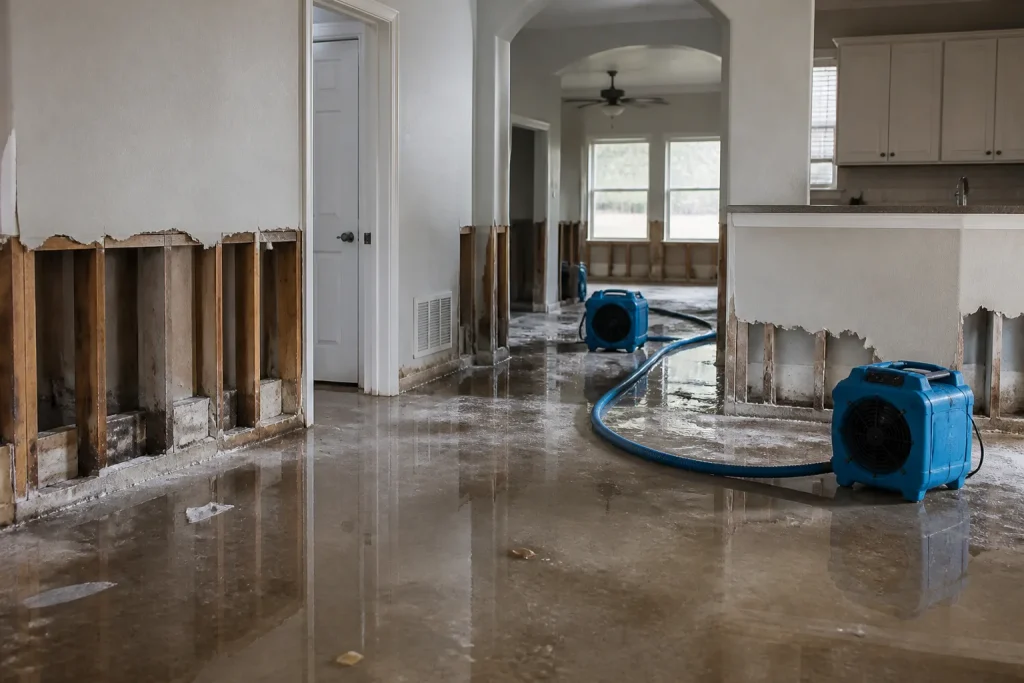
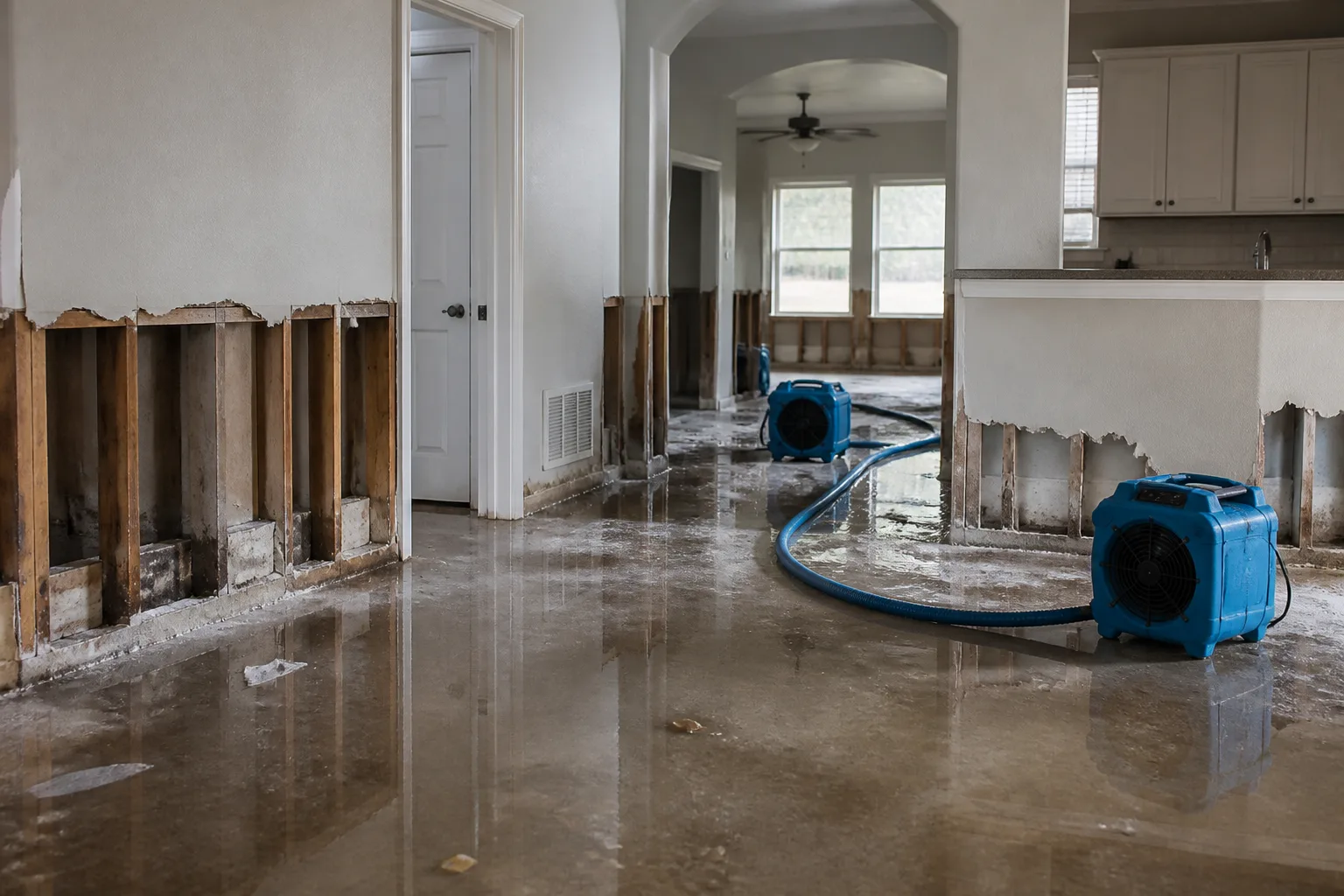
B-Air makes air movers and dehumidifiers, and they make them well. The confusion starts when homeowners think any fan plus any dehumidifier equals drying. It doesn’t. There are two kinds of B-Air air movers you’ll typically see on a Houston water job: axial and centrifugal. Axial movers push a wide, fast stream of air across a floor. Centrifugal movers focus a narrower, higher-pressure stream, which is what you want for getting air into wall cavities and under cabinets.
Then there’s the dehumidifier side. B-Air’s LGR (low grain refrigerant) units pull moisture out of the air itself. LGR matters in Houston because our ambient humidity runs high most of the year, and a standard refrigerant dehumidifier simply can’t drive vapor pressure down far enough to pull water out of drywall and hardwood. If a crew shows up with only air movers and no LGR dehumidifier on a Category 2 or 3 loss, the drying plan is already behind schedule. We run B-Air alongside Dri-Eaz and Phoenix units on Houston jobs because different chambers and floor plans demand different equipment profiles.
Placement Logic: Why 3,000 CFM Can Miss the Wall Cavity
Here’s the thing that separates a real drying job from a noisy one. A big axial B-Air mover can push 3,000 cubic feet per minute across your tile floor. That air moves fast. It feels impressive. But if the water is trapped inside a wall cavity between the drywall and the studs, surface airflow across the face of the drywall does very little. The moisture is sitting behind the surface, and you need directed pressure or negative pressure to reach it.
A trained restoration technician calculates airflow path before setting a single unit down. The angle of the air against the wall surface matters, sometimes by inches. Air should hit the wet surface at roughly a 45-degree angle, not straight-on and not parallel. Straight-on airflow bounces back and creates turbulence without penetration. Parallel airflow skates past. And the placement isn’t set-and-forget. Daily moisture readings should drive repositioning. As one area dries and another lingers, the movers shift. If a crew in a Houston house never moves the equipment for five days, they weren’t reading the structure.
Houston’s Climate Changes the Drying Math
Most of the drying charts you’ll find online were written for places with drier air. Houston sits in a subtropical humidity zone. From May through October, our outdoor air routinely holds 70 to 90 percent relative humidity. That means a dehumidifier has to work against a constant inbound moisture load every time a door opens or a window seal leaks. The dry standard, the point where materials are considered fully dried, is not a single number. It’s a comparison against an unaffected baseline in the same structure.
A legitimate drying company in Houston takes baseline readings from dry materials in your home before setting targets. If the unaffected wall cavity in your hallway reads 9 percent moisture content, the affected wall should return to within 2 to 4 points of that, not to some generic “10 percent” chart number. Grain pressure readings, measured in grains per pound of air, tell the technician whether water vapor is actually leaving the wet material and entering the air stream. Skipping this step in Houston means leaving walls at 90 percent relative humidity indefinitely, which is how mold takes hold in an otherwise cleaned room.
What a Real Drying Log Looks Like
You should not have to ask for a drying log. It should be handed to you on day one and updated daily. A legitimate log lists each affected material: the drywall in the laundry room, the baseboard along the south wall, the subfloor under the hallway carpet. Next to each material, it records the moisture reading from that day, the target dry standard, and the equipment running against it. If a crew cannot produce a daily log with per-material readings, the job is being run on guesswork.
Houston homeowners should also watch for overcorrection. This is the failure point almost nobody warns you about. Equipment left running past the drying goal creates secondary damage. Wood framing can be driven to 6 or 7 percent moisture content, which causes cracking and nail pops. Drywall seams start to open. Hardwood cupping reverses into gapping. A technician’s job is to know when to pull equipment, not just when to start it. We pulled a B-Air setup out of a garage over in Meyerland last spring where the previous company had left three movers and an LGR running for nine straight days after the structure had already reached dry standard. The homeowner’s baseboards were warped worse at the end than the day after the flood. Runtime is not the goal. The endpoint is the goal.
When to call a pro: if your drying log is missing, if no one has taken a moisture reading in 48 hours, or if the equipment has been running beyond the target without anyone explaining why, that’s the moment to call (888) 977-4690. A second set of eyes from a certified team costs you a phone call.
Equipment Decisions That Connect to Rebuild Scope
One of the quiet disasters in Houston restoration work is the handoff. A mitigation crew extracts and dries, then a different reconstruction crew shows up weeks later with no knowledge of what was wet, how wet it got, or where the drying plan succeeded or struggled. That’s how you get a rebuilt wall that covers a still-damp stud, or a fresh paint job over a drywall seam that never fully recovered.
At Floodline Restoration Co. of Houston, the same certified crew that places the B-Air movers and logs the daily grain pressure readings is the crew that handles the rebuild. That means the moisture map from day one carries straight into the scope of work for reconstruction. A wall that took nine days to reach dry standard instead of four gets documented as a material to watch. A subfloor that absorbed water for six hours before extraction started gets noted for potential fastener replacement. None of that information survives a handoff between two companies. It does survive when the same people hold the job from the floodline to the finished wall.
We also bill the carrier directly. That means the drying log, the equipment list, the daily readings, all of it goes straight to your insurance adjuster without you acting as the messenger. Photo documentation of the B-Air placement, the moisture meter readings, and the progression of the dry-down is captured daily. When the adjuster questions a line item, the log answers it. That’s the square deal our customers in Houston have counted on since Curt Bowman founded this company in 2010.
Direct Answers for Homeowners Checking a B-Air Setup
- How do I know if the B-Air mover is positioned right? You should see air hitting wet surfaces at an angle, not straight-on. If the unit is pointed at open floor space with no wet material in the path, it’s moving air for show.
- Is the dehumidifier actually pulling water? Check the collection tank or drain hose. In Houston, an LGR dehumidifier on an active wet job should be pulling pints per hour, not drips. If it’s barely producing water after day one, the room isn’t sealed or the unit is undersized.
- How long should equipment run in Houston? Most Houston jobs take three to five days to reach dry standard. If a company refuses to show you a moisture meter reading and simply says “we’ll run it for a week,” that’s a red flag.
- What’s a fair price for B-Air drying equipment in Houston? Equipment rental line items typically run $40 to $70 per day per air mover and $90 to $140 per day per LGR dehumidifier, depending on capacity. But monitor the daily log. You’re paying for progress, not for a unit to sit in a dry room.
Related services in Houston: Water Damage Restoration in Houston covers the full extraction and drying process from the first call. If water sat for more than 48 hours, Mold Remediation in Houston should be part of the conversation. And if the water came with smoke or soot from a fire event, see Fire & Smoke Damage Restoration in Houston. Floodline Restoration Co. of Houston home is where you’ll find the full scope of what we do.
The Bottom Line
B-Air makes solid equipment, but no air mover dries a house by itself. The skill is in the placement, the daily readings, and the judgment to know when the structure has hit dry standard and the equipment should be pulled. Houston’s humidity makes that judgment harder, not easier. If you’re in the middle of a water damage event and the drying log isn’t being updated daily, or the equipment has been running past the target without explanation, that’s the moment to get a second opinion.
If you’re in Houston and need help, Floodline Restoration Co. of Houston offers free estimates. Call (888) 977-4690 and a live person answers, day or night. We’ll read the moisture log, check the placement, and tell you straight whether the current setup is drying your house or just running up the meter. Done right, and backed in writing.
Frequently Asked Questions
A B-Air air mover pushes large volumes of air across wet surfaces, which accelerates evaporation by carrying moisture away from the material and into the air stream. In Houston, it must be paired with an LGR dehumidifier to remove that moisture from the air, otherwise the evaporated water simply re-condenses on cooler surfaces.
A standard single-room water loss in Houston usually needs two to four air movers plus one LGR dehumidifier, but the real number depends on the affected square footage, the materials involved, and the depth of water penetration. A hardwood floor with a crawlspace beneath it dries differently than tile over a slab. The only honest answer is a moisture map and a written drying plan.
You can rent the equipment, but the equipment is the easy part. The hard part is reading the moisture meters, calculating grain pressure differentials, sealing the drying chamber, and knowing when to stop. In Houston’s humidity, a homeowner-run drying job frequently leaves enough residual moisture for mold to colonize behind the baseboards. If you’re set on DIY, at minimum get a professional moisture assessment before you start and after you finish. Call (888) 977-4690 and we’ll walk you through what to look for.
The equipment is done when affected materials return to within 2 to 4 points of the unaffected baseline readings taken in your home, not when a timer runs out. A professional drying log will show daily per-material readings trending toward the dry standard. If the log isn’t moving, the placement or the equipment is wrong. If the log has been flat for two days, the job is either finished or stuck. Either way, someone should be telling you which.
Most homeowner policies cover drying equipment as part of the water damage mitigation scope, but the carrier wants documentation: daily moisture logs, photo evidence of the equipment in place, and a clear dry standard. Floodline Restoration Co. of Houston bills your insurance carrier directly and sends the daily log with the invoice, so you never play messenger between us and your adjuster. For a free estimate and a straight answer on your policy, call (888) 977-4690.
Written by Curt Bowman, Owner at Floodline Restoration Co. of Houston, serving Houston since 2010.
Need Damage Restoration Help?
Call Floodline Restoration Co. of Houston - licensed & insured, here with fast after-hours help in Houston.
(888) 977-4690