
Water Damage Restoration Pricing Breakdown: What Houston Homeowners Pay in 2026
Water damage restoration in Houston runs $2,900 to $9,800 for most single-room incidents in 2026, with full-home losses from Category 3 water regularly reaching $25,000 to $60,000 once rebuild is included. The spread exists because two contractors can look at the same flooded hallway and see entirely different jobs, one billing for extraction and a few days of fans, the other for structural drying, demo, and rebuild. If you’d rather skip the guesswork, call Floodline Restoration Co. of Houston home at (888) 977-4690 and we’ll walk the scope with you before any money changes hands.
The average Texas water damage claim settled for $11,605 in 2025. That number gets quoted a lot, but it hides more than it reveals. Two houses in Meyerland with identical square footage and the same burst supply line can see quotes $8,000 apart depending on whether the contractor builds a scope from an actual moisture map or starts plugging Xactimate line items into a template. This post breaks down where that money actually goes in the Houston market, what drives the price up here specifically, and how to read a restoration quote so you know what you’re paying for before the crew rolls up.
Key Takeaways
- Extraction-only jobs for clean water caught within hours: $1,800 to $4,200 in Houston.
- Mid-range structural drying with equipment days and daily monitoring: $4,500 to $9,800.
- Category 3 losses or hidden moisture requiring demo and rebuild: $15,000 to $60,000+ depending on finishes and square footage.
- Houston’s humidity extends drying times, which directly increases equipment-day billing, the single most variable line item.
- A low quote usually means excluded scope, not efficiency. Demo, content handling, and mold treatment are the three most common carve-outs.
The Three Real Cost Tiers: What Houston Water Damage Jobs Actually Look Like
Restoration pricing in Houston breaks into three honest tiers, and knowing which one you’re in matters more than any single number on a quote. The tiers are defined by water category, elapsed time, and how far moisture has traveled into materials. A contractor who can’t tell you which tier you’re in after an inspection didn’t actually inspect.
Tier 1: Extraction-Only (Category 1 Clean Water, Caught Fast)
This is the best-case scenario. A supply line bursts under a sink while you’re home. You shut the water off in ten minutes. The water never touched sewage, never sat overnight, and your floors are tile or sealed concrete. A crew extracts standing water, sets a few air movers for two or three days, checks moisture readings, and leaves. In Houston, expect $1,800 to $4,200 for a single room or hallway. Most of that is labor, equipment minimums, and the trip charge built into every restoration invoice. If you’re in this tier, you got lucky. A Water Damage Restoration in Houston company doing honest work should be able to produce a moisture log showing the dry standard was met before equipment came out.
Tier 2: Structural Drying (Moisture in Walls, Baseboards, Subfloor)
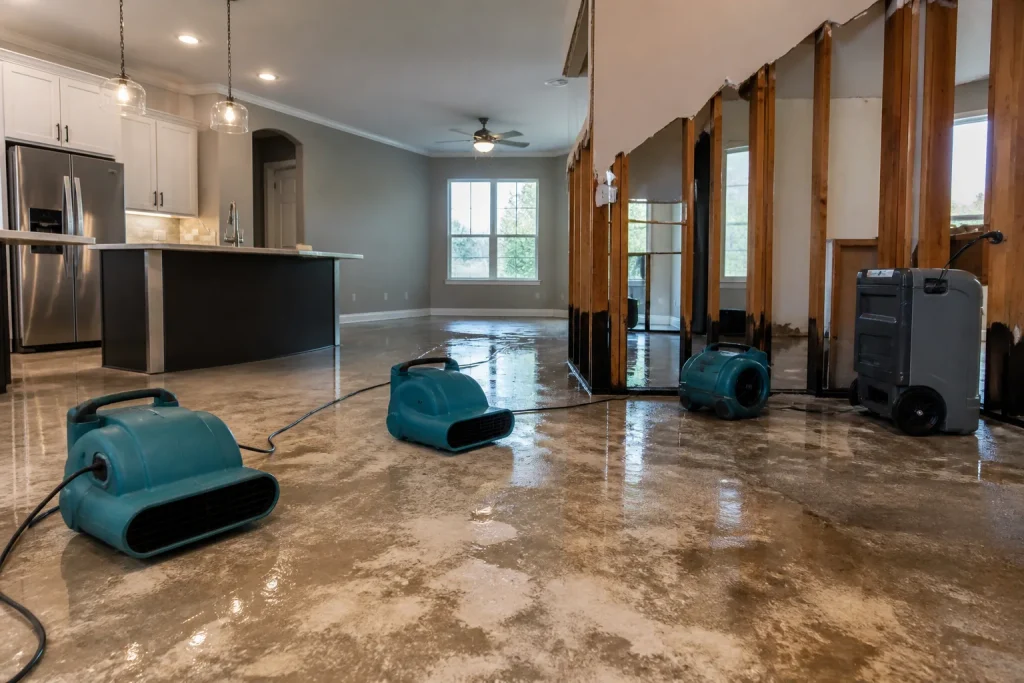
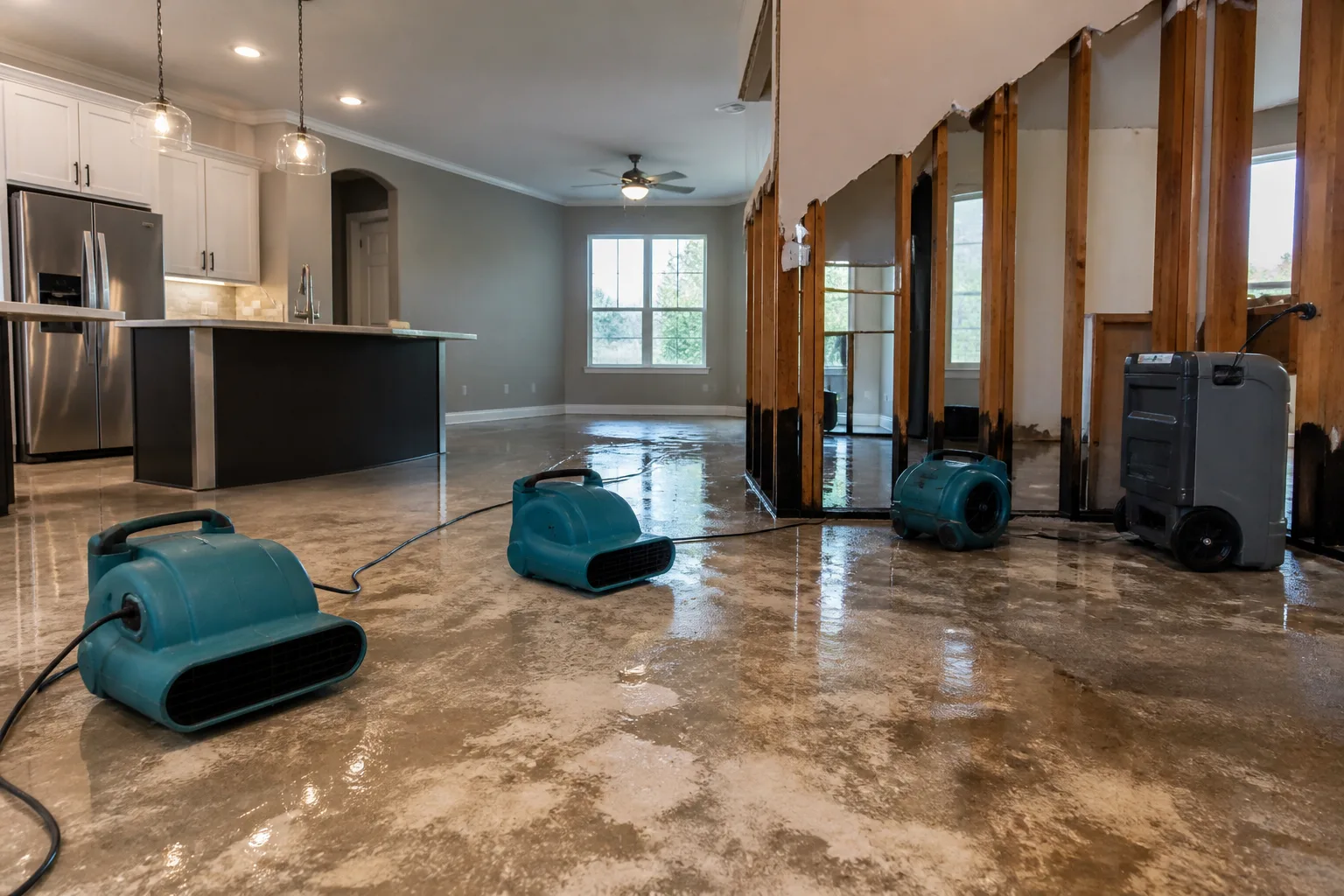
Water sat for a few hours or traveled under baseboards into drywall and subfloor. The visible puddle is gone, but the real problem is what you can’t see. This requires professional-grade drying equipment: Dri-Eaz and Phoenix dehumidifiers, XPOWER air movers, and in some cases Injectidry systems pulling water out of wall cavities without tearing everything open. Equipment runs for five to ten days in Houston’s ambient humidity, sometimes longer in July and August. The cost: $4,500 to $9,800 for a typical one or two room loss. The equipment days are the driver here. A company charging per day should show you daily moisture readings. A company that won’t show readings is billing blind.
Tier 3: Full-Cycle Loss (Category 3 Water, Extended Hidden Moisture, or Rebuild Required)
This is sewage, storm surge, a slab leak that ran for a week behind walls, or any loss where drywall, insulation, and flooring have to come out. Demo, content pack-out, antimicrobial application, structural drying, and rebuild of drywall, paint, and flooring. Houston homes in flood zones or on pier-and-beam foundations often land here faster than homeowners expect. Costs run $15,000 to $60,000 and up. The range is wide because rebuild materials vary enormously: a 1,200 square foot Heights bungalow with original wood floors costs different money to restore than a track home in Katy with laminate and carpet. This is where a written scope becomes non-negotiable.
How Xactimate Line Items Work, and Why a Low Bid Is Usually a Scope Exclusion
Nearly every carrier and restoration contractor in Houston prices through Xactimate, a software platform with standardized line items for every imaginable restoration task. Each line item carries a regional price. Carriers use it to build estimates. Contractors use it to submit bills. The problem: Xactimate is a language, and whoever controls the translation controls the price.
A quote that looks cheap is usually missing lines, not finding efficiencies. The three most common carve-outs we see in the Houston market:
- Demo not included. The quote covers extraction and drying, but ripping out wet drywall and hauling it away gets billed later as a supplement. You discover this when the crew stops and says demo requires a change order.
- Content pack-out billed separately. Moving furniture, boxing contents, and storing items while drying happens is line-itemed by room, by hour, by box. Some contractors leave it off entirely and bill it as an add-on once your sofa is sitting in the driveway.
- Mold treatment carved out. In Houston’s humidity, mold can start within 24 to 48 hours. A restoration quote that doesn’t include antimicrobial application or mold remediation language is a quote for a half-finished job. If you’re seeing early signs, the Mold Remediation in Houston scope should be in the same written plan, not a surprise invoice later.
Curiously, a higher quote is sometimes the more honest one because it includes the full cycle. The right question isn’t “why is this so expensive?” It’s “what’s excluded, and what happens when you find more damage after demo?” If the contractor can’t answer that in writing, keep looking.
Houston-Specific Cost Drivers: Humidity, Foundations, and Flood-Zone Code
Restoration costs vary by region, and Houston has three structural realities that push prices in specific directions.
Ambient humidity extends drying time. Houston averages over 70% relative humidity most of the year. Every day a dehumidifier runs is a billable equipment day. A loss that dries in 4 days in Phoenix can take 8 in Houston between May and October. That’s not padding. That’s physics. But it’s also why daily moisture readings matter, you shouldn’t pay for equipment days past the point the dry standard is met, and a contractor running Dri-Eaz or Phoenix desiccant dehumidifiers can hit the dry standard faster than someone using consumer-grade units from a big box store, because the extraction rate is materially different. Equipment quality is a cost driver with a real dollar value.
Pier-and-beam foundations change the extraction method. A significant share of older Houston homes, especially inside the Loop, sit on pier-and-beam. Water goes down, not just sideways. Crawlspace extraction, encapsulation, and under-floor drying are entirely different line items than slab drying. A contractor who doesn’t send someone under the house during inspection is quoting blind, and the supplement will show up later.
Flood-zone homes trigger additional code compliance. Harris County flood zones, especially areas affected by repeated flooding since Harvey, often require elevation certificates, updated electrical elevation, and specific materials on rebuild if the loss exceeds a certain threshold of the home’s value. That’s not a restoration contractor inventing costs. It’s code. But it should be explained up front, not discovered when the permit gets pulled.
How Direct Insurance Billing Actually Works, and What “We Work With All Insurance Companies” Really Means
This paragraph may save you more money than every other word in this post.
“We work with all insurance companies” usually means one thing: the contractor sends you the bill, and you fight the carrier for reimbursement. That’s the standard model in this industry. It works if your claim is straightforward, your adjuster is responsive, and you have the cash flow to float a $9,000 invoice for 60 days.
Direct insurance billing means something different. It means the contractor submits the scope and estimate to the carrier, negotiates supplements when additional damage is found, documents the work with photo records and moisture logs, and bills the carrier directly. The homeowner never plays messenger. This is the model Curt Bowman built Floodline around, because the messenger role is where claims stall, and a stalled claim is how a $15,000 loss becomes a $40,000 loss with mold, structural rot, and a family living in a hotel.
If you’re comparing quotes, ask one specific question: “Do you bill my carrier directly, or do I pay out of pocket and seek reimbursement?” The answer changes your cash position, your claim timeline, and your stress level for months.
What the 90-Day Done Right Promise Costs the Contractor, Not the Homeowner
Warranties on restoration work are rare enough that they function as a price signal. A company willing to put a 90-day written guarantee on completed work is a company confident enough in its drying protocols to bet its own money that mold won’t return, seams won’t open, and the rebuild will hold.
We call it the 90-Day Done Right Promise, the Keystone Standard around Floodline. It’s in writing. No arguing. If something isn’t right within 90 days of completion, we make it right. That promise costs us money when we get something wrong, and it’s designed to. It costs the homeowner nothing. Any restoration quote worth serious consideration should include some version of this, in writing, signed, before work starts. If the contractor won’t put a warranty on the paper, ask yourself what they’re afraid of.
And the guarantee should cover the full cycle, extraction through rebuild. A drying-only company can promise you dry. A rebuild-only contractor can promise you new drywall. But when the two are different companies and something fails, you’ll get finger-pointing, not fixes. One of the quiet advantages of a full-cycle contractor is that there’s no one to point at.
When to Call a Pro
Call a restoration professional the moment the water source is stopped or contained. Every hour of delay in Houston humidity moves you from Tier 1 toward Tier 3. If you see standing water that has touched a wall, water staining that appeared more than 24 hours ago, any water that may have come from sewage or outside flooding, or you smell something musty that wasn’t there last week, call us at (888) 977-4690. A live dispatcher answers, any hour, any day, and a certified crew can be on site the same visit. We routinely pull jobs out of homes in Meyerland, the Heights, and Katy where the homeowner thought a wet hallway would “dry on its own.” It doesn’t. It didn’t. It won’t.
The Bottom Line
Houston water damage restoration ranges from under $4,200 for a fast-caught clean water loss to over $60,000 for a full-cycle Category 3 job with rebuild. The most useful thing you can do is stop comparing bottom-line numbers and start comparing scope: what’s included, what’s excluded, who handles the insurance carrier, and whether the work comes with a written guarantee. A low price is only a bargain if the scope matches the actual moisture map, and the only way to know is a real inspection with real readings.
If you’re in Houston and need help, Fire & Smoke Damage Restoration in Houston follows the same scope-first discipline as our water division, but for water specifically, Floodline Restoration Co. of Houston offers free estimates. Call (888) 977-4690. We’ll be there when we say, and the line the water left is where we start.
Frequently Asked Questions
Most Houston homeowners pay between $2,900 and $9,800 for typical single-room water damage, with full-cycle losses involving contaminated water or rebuild ranging from $15,000 to $60,000 or more. The final number depends on water category, how long it sat, and how far moisture traveled into structural materials.
Coverage depends on the water source. Sudden and accidental events, like a burst supply line or a water heater failure, are typically covered. Gradual leaks, lack of maintenance, and flood water (without a separate flood policy) are commonly excluded. The fastest way to know is to check your policy’s water damage section, then call a contractor who handles direct insurance billing so the scope goes to the adjuster with documentation. Call (888) 977-4690 and we’ll photograph everything on day one.
Floodline Restoration Co. of Houston has live dispatch 24 hours a day, every day. A certified crew can reach Houston-area homes the same visit in most cases, with extraction running before the day is out. Speed matters most in the first 48 hours, because that’s the window before mold begins in Houston’s humidity.
If it’s clean water, small in area, and you catch it within the hour, you can mop it up and run fans. But you can’t see moisture inside wall cavities or under flooring without moisture meters, and those hidden pockets are exactly where mold starts and structures rot. Any water that touched sewage, sat overnight, or spread under baseboards deserves professional assessment. The inspection costs you nothing with us. The repair after a week of waiting costs a lot.
Written by Curt Bowman, Owner at Floodline Restoration Co. of Houston, serving Houston since 2010.
Need Damage Restoration Help?
Call Floodline Restoration Co. of Houston - licensed & insured, here with fast after-hours help in Houston.
(888) 977-4690