
Fast, Reliable Sewage Cleanup Across Dayton
Sewage cleanup in Dayton, TX typically costs $400 to $1,200 per room for full extraction, sanitization, and drying, and we can usually have a crew at your door within 60 to 90 minutes. That’s what matters when black water is backing up into a hallway or pooling under a pier-and-beam house off FM 1960. Call (888) 977-4690 now and you’ll get a live dispatcher, not a recording, no matter what time it is. Our sewage cleanup teams know Dayton’s flood history, its older housing stock, and its stubborn humidity, and we’re ready to get extraction running on the first visit.
Why Floodline Restoration Co. of Houston Is Dayton’s Preferred Sewage Cleanup Company
Dayton homeowners have learned the hard way which contractors actually show up. After Harvey, after Imelda, after every spring storm that pushed the Trinity River over its banks, this town got flooded with out-of-state crews who disappeared once the checks cleared. Floodline Restoration Co. of Houston has a different approach. We’ve spent 42 years building a reputation in Southeast Texas, not just through a dispatch board, and our Dayton customers call back because the work holds up. Every job is backed by the 90-Day Done Right Promise, the Keystone Standard, given in writing with no arguing and no paperwork battles.
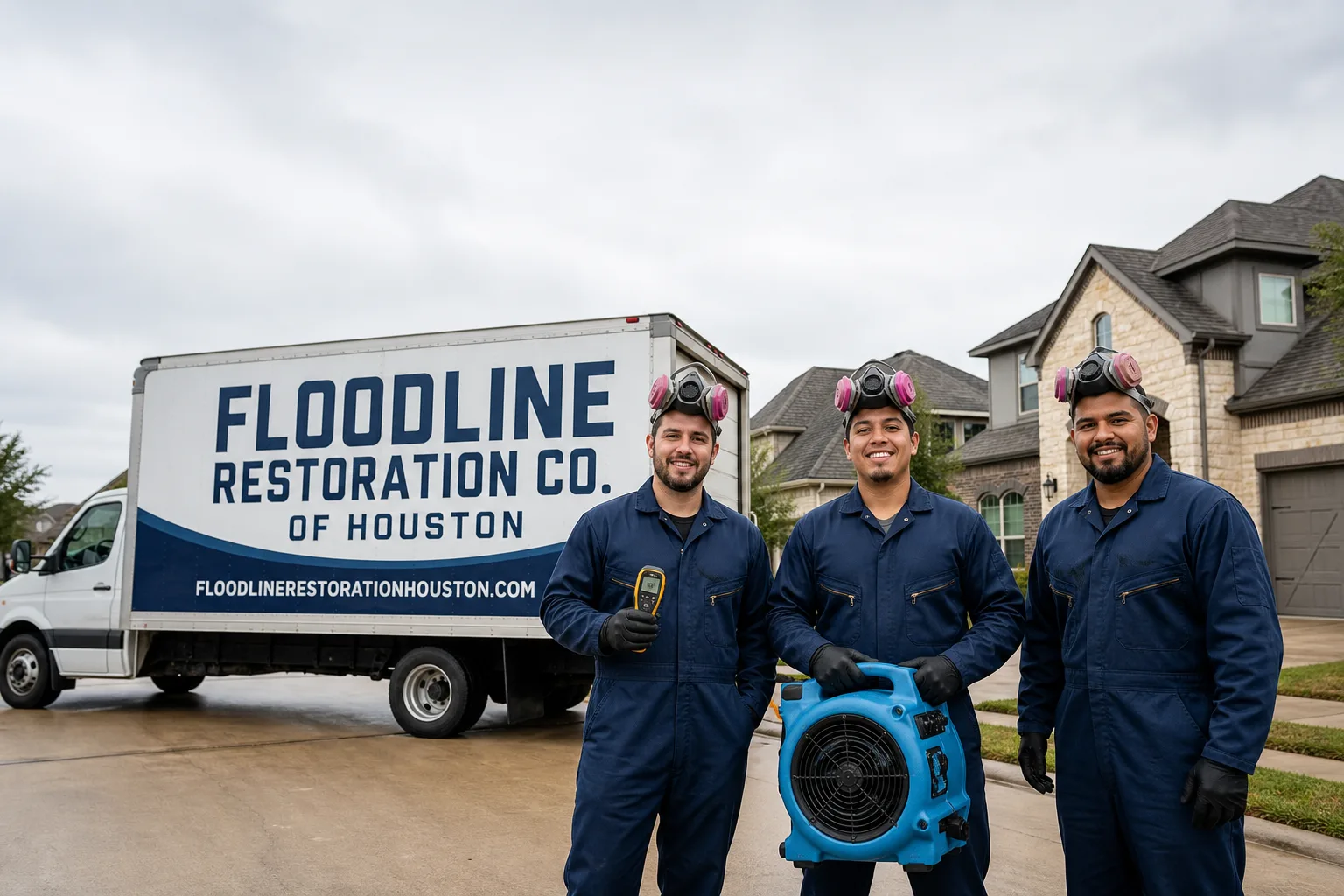
Response time matters in Dayton, especially when a lifted septic line or a failing lift station forces sewage up through a floor drain after heavy rain. Our crews are dispatched from Houston and serve Dayton directly, with background-checked, uniformed technicians who arrive in marked trucks carrying Dri-Eaz and XPOWER equipment. We train our people to IICRC, RIA, and IFA standards, and they document every step with photos for your insurance carrier. The homeowner never plays messenger between us and the adjuster.
Our Sewage Cleanup Services in Dayton
Four problems account for most of the sewage calls we get in Dayton. Here’s how we handle each one.
Sewage Backup Cleanup
When the city’s aging lines back up during a heavy rain event, raw sewage pushes through tub drains and floor toilets in Dayton’s low-lying neighborhoods near the Trinity River. Our team extracts the black water, cuts out contaminated drywall, and sanitizes every surface with IICRC-compliant disinfectants. We then set up drying equipment and log moisture readings daily until the dry standard is met. The goal isn’t just a clean-looking room; it’s a subfloor and wall cavity that won’t feed mold three weeks later.
Toilet Overflow Cleanup
A toilet overflow in an older Dayton home, especially a wood-frame house built in the 1960s or 1970s, often spreads faster than people expect. Water wicks into the subfloor and under vinyl sheeting before you can shut the valve. We extract, remove affected flooring, sanitize the area, and dry it down properly. Where we find Harvey-era drywall that was never fully remediated, we tell you before we cut, so there are no surprises on the scope.
Septic Failure Cleanup
Septic failure cleanup is a major part of our work in Dayton because so much of the housing stock sits outside the city sewer grid. Homes along CR 62, CR 686, and the farm-to-market roads stretching toward Liberty rely on aging septic systems. When a tank overflows or a drain field saturates, black water can pool under a manufactured home or seep into a crawl space unnoticed for weeks. That’s where our Sewage Cleanup team does its most demanding work: removing the waste, tearing out soaked underbelly insulation, and treating floor joists, then sealing the crawl space to stop the cycle.
Black Water Extraction
Black water, the classification for water containing human waste, carries pathogens that require full PPE and controlled disposal. In Dayton, we’ve extracted black water from flooded crawl spaces, from living rooms after lift-station overflows, and from under bedrooms in manufactured homes where a pipe separated below the floor. Our crews handle it as a biohazard, not a mop job. That means proper containment, proper disposal, and a hospital-grade sanitization pass before any rebuild begins.
What happens when you call
- 1
A real person answersNo phone trees - you reach a local pro.
- 2
You get an upfront price rangeHonest numbers before anyone is dispatched.
- 3
A background-checked tech heads outLicensed & insured, dispatched right away.
- 4
You approve before work beginsNothing starts until you say go.
Trusted Brands We Service in Dayton
Floodline Restoration Co. runs professional-grade equipment because Dayton’s conditions demand it. We use XPOWER air movers and B-Air fans for the high-velocity drying that fights Southeast Texas humidity, and Injectidry panels for flooring and cavity drying when sewage has wicked into hard-to-reach spaces. Our technicians carry IICRC and RIA certifications and use equipment that actually moves enough air to dry a pier-and-beam subfloor before mold takes hold. For Dayton homeowners, that means a faster dry, a cleaner crawl space, and documentation your carrier accepts without a fight.
Common Sewage Cleanup Problems We See in Dayton Homes
- Harvey-era walls hiding mold that reactivates on new moisture. When a fresh sewage backup soaks drywall that was never fully remediated after 2017, dormant mold colonies can bloom within 48 hours. We cut to the studs where needed and don’t just patch over it.
- Manufactured home underbellies trapping black water from septic failure. The underbelly acts like a sponge, holding waste against the subfloor until the flooring buckles and the smell gives it away. We remove the insulation, treat the framing, and replace the vapor barrier.
- High humidity slowing the dry. Dayton averages over 75% relative humidity most of the year. Porous wood that would dry in three days in West Texas can stay damp for a week here, which is exactly the window mold needs. We run daily readings and keep equipment on-site until the numbers prove dry.
- Older pier-and-beam homes hiding sewage in the crawl space. A broken cast-iron or clay pipe under a 1960s Dayton home can spill waste into the crawl space for weeks before anyone notices the odor. By then it’s a structural issue, not just a cleaning issue.
Pricing for Sewage Cleanup in Dayton, TX
We Also Serve Cities Near Dayton
Beyond Dayton, our crews regularly handle sewage cleanup for neighbors in Liberty, Mont Belvieu, Highlands, and Atascocita. If your home sits outside the city limits or off Highway 321 toward Mont Belvieu, we’re still close enough to get there fast. Sewage Cleanup in Dayton and the surrounding Liberty County area is what we do every day.
Serving Dayton, TX - Our Local Coverage Area
We’re based in the Dayton area and know this community well, offering services like Water Damage Restoration in Dayton. Use the map below to see our service coverage - if you’re nearby, we can almost certainly help.
FAQs - Sewage Cleanup in Dayton
How does Dayton’s high humidity affect sewage cleanup drying times compared to drier Texas cities?
Dayton’s near-constant relative humidity above 75% means sewage cleanup drying takes one to three days longer than the same job in a dry market like Amarillo or El Paso. We account for that by running more air movement, sealed containment, and daily moisture readings until the dry standard is met, not a guess. If your home is in Dayton’s 77535 ZIP, expect our drying plan to be built around Southeast Texas conditions, not a generic template.
Are older pier-and-beam homes in Dayton more likely to hide sewage backups in the crawl space?
Yes, and we see it routinely. Dayton’s mid-20th-century pier-and-beam homes place plumbing and waste lines in a dark, ventilated crawl space where a slow leak or full separation can go unnoticed for weeks. Black water pools, soaks the subfloor and joists, and by the time the odor reaches the living space, the damage is structural. Our crawl space sewage removal service specifically addresses this Dayton housing type.
What special steps are needed for sewage cleanup in a manufactured home after flooding?
Manufactured homes in Dayton and rural Liberty County need the underbelly opened and inspected after any black water intrusion. Waste trapped in the underbelly insulation against the subfloor feeds mold and rots the decking from below. We remove the saturated insulation, treat the framing with IICRC-compliant sanitizers, dry the cavity with Injectidry and XPOWER equipment, and install a new vapor barrier before closing it back up.
How does previous Hurricane Harvey damage affect the way you handle sewage backups in Dayton?
Many Dayton homes flooded during Harvey were repaired with new drywall and insulation but never fully remediated to the studs. The leftover mold inside the wall cavities stays dormant until a new moisture source, like a sewage backup, reactivates it. When our crew cuts into a wall in Dayton, we look for that signature gray staining and treat it as a two-part problem: the fresh sewage and the old mold. Skipping the second part means the smell and the spores return.
Why is septic failure cleanup more common in Liberty County than in Houston proper?
Dayton sits outside Houston’s municipal sewer service boundary, so homes across the 77535 ZIP and the surrounding county rely on individual septic systems. Those systems age, flood, and overflow, particularly in the low-lying areas near the Trinity River where the water table rises after heavy rain. Houston proper has fewer septic systems per square mile, which makes this problem far more common in Dayton and Liberty County. Our teams carry the equipment and the experience specific to septic failure cleanup because we know it’s a recurring need here.
Call Floodline Restoration Co. for Sewage Cleanup in Dayton
If sewage is backing up in your Dayton home right now, call (888) 977-4690. You’ll reach a live dispatcher immediately, and we’ll give you a straight answer about when our crew can get there. If you’re calling about a slower problem, like a smell that won’t go away or a soft spot in the floor near a bathroom, call anyway. We’ll talk through what you’re seeing and tell you honestly whether you need us. Every sewage cleanup job in Dayton comes with the 90-Day Done Right Promise in writing, direct insurance billing with photo documentation sent to your adjuster, and the same certified crew from first extraction to finished repair. We’ll be there when we say.
Written by Curt Bowman, Owner at Floodline Restoration Co. of Houston, serving Dayton since 2010.