
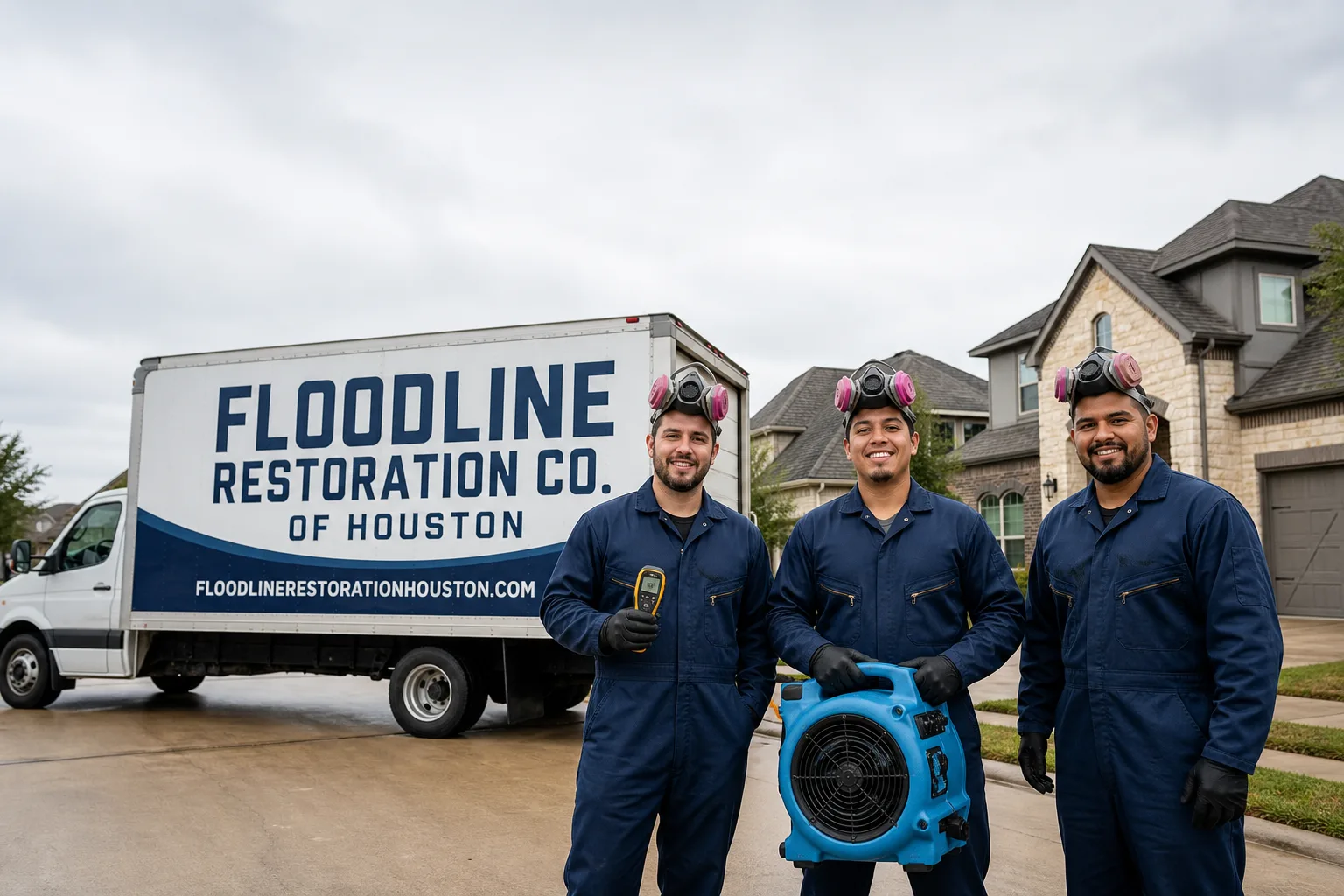
Fast, Reliable Storm & Disaster Restoration Across Richmond
Storm damage in Richmond doesn’t wait for business hours, and neither do we. Floodline Restoration Co. of Houston runs live dispatch 24/7, which means when a Brazos River flood event or a spring squall tears through 77406, 77407, or 77469, a real person answers at (888) 977-4690 and a certified crew is rolling toward your street. We know Richmond’s flood profile intimately: the Brazos River, the expansive clay soils, the post-2000 master-planned construction that holds water differently than the older pier-and-beam homes along Morton Street. Our Storm & Disaster Restoration crews have walked these neighborhoods, mapped these wall cavities, and dried these homes after the worst storms Fort Bend County can throw. If you’re standing in a wet house right now, call us. We’ll be there when we say.
Why Floodline Restoration Co. of Houston Is Richmond’s Preferred Storm & Disaster Restoration Company
Richmond homeowners call us because we show up with the right equipment and the right plan, and we don’t leave until the job is done right and backed in writing. Curt Bowman founded this company in 2010 around a dispatch board, not a sales desk, and that single decision shapes everything about how we work: live phone answer at 2 a.m., background-checked uniformed technicians on every job, and a 90-Day Done Right Promise, the Keystone Standard, handed to you in writing. No arguing, no paperwork battles. If it’s not done right, we make it right.
The Storm & Disaster Restoration in Richmond work we do carries extra weight here because of the Brazos. We know what prolonged saturation does to engineered lumber framing and OSB sheathing in Long Meadow Farms and Grand Mission. We know what Houston Black clay does to slabs after a flood year. And we know that a wall that feels dry in Pecan Grove can read 35 to 60 percent moisture content at mid-stud. That’s why our crews moisture-map every wall cavity, log daily readings, and hand you and your carrier a moisture log when the dry standard is met. That specific local knowledge is why Richmond homeowners keep our number.
Our Storm & Disaster Restoration Services in Richmond
Storm Damage Cleanup
Richmond storms leave a mess that goes deeper than downed limbs. Wind-driven rain finds its way through roof edges, window flashing, and the hairline cracks in slab foundations that Houston Black clay has been slow-working for years. Our storm damage cleanup starts with a full assessment of where water actually went, not just where you can see it. We extract, we dry, we document. Then we rebuild what needs rebuilding so you’re not left with a half-finished house and a carrier that won’t return calls. Most jobs are completed in a single visit by the same crew that started them.
Flood Damage Restoration
This is the work Richmond knows us for. When the Brazos crested during Hurricane Harvey, entire neighborhoods across 77406 and 77469 sat in standing water for four to seven days. That is not a storm-drain backup. That is prolonged saturation that drives moisture into wall cavities, subfloor assemblies, and crawl spaces long before the water recedes. Our flood damage restoration protocol in Richmond accounts for that timeline. We use Dri-Eaz moisture meters to map every cavity, Injectidry floor-drying mats for subfloors, and Phoenix axial fans to move air through spaces most crews never open. The line the water left is where we start, and we don’t stop until the moisture log says the dry standard is met.
Emergency Board-Up
When a Richmond storm puts a tree limb through a window or strips shingles off a roof, your house is open to three things: more rain, pests, and people who don’t belong there. Our emergency board-up crews respond fast, secure the opening with professional-grade materials, and keep a written scope of the temporary work so your carrier sees exactly what we did. For homes in Richmond’s older core along Morton Street, we’re careful with the historic fabric. We don’t over-nail, we don’t oversecure, and we photograph everything before and after. Direct insurance billing means you don’t play messenger.
Roof Tarping
A tarp is a temporary roof, but only if it’s installed right. We see plenty of Richmond tarps from other crews that flap loose in the next wind event and let water in around the edges. Our roof tarping uses reinforced, UV-stabilized coverings anchored to withstand Fort Bend County weather, and we document the installation with photos for your adjuster. For the post-2000 homes in Pecan Grove with steep pitches and complex rooflines, we cut and secure tarps on site, not with a pre-cut square that leaves gaps. Fast, solid, and standing behind it.
What happens when you call
- 1
A real person answersNo phone trees - you reach a local pro.
- 2
You get an upfront price rangeHonest numbers before anyone is dispatched.
- 3
A background-checked tech heads outLicensed & insured, dispatched right away.
- 4
You approve before work beginsNothing starts until you say go.
Trusted Brands We Service in Richmond
Our Richmond crews run professional-grade drying equipment from XPOWER, B-Air, and Injectidry, and every technician carries IICRC certification. That matters when you’re comparing restoration companies, because the equipment in the truck determines how fast your house actually dries. We stock common parts and consumables in our Houston dispatch center so Richmond jobs don’t wait on a supply order. Whether we’re setting Injectidry mats on a Long Meadow Farms subfloor or repositioning B-Air air movers in a downtown Richmond pier-and-beam crawl space, the equipment is the same grade we’d want in our own homes. Done right, and backed in writing.
Common Storm & Disaster Restoration Problems We See in Richmond Homes
- Walls that feel dry but aren’t. In Pecan Grove after Harvey, exterior drywall routinely read 35-60% moisture content at mid-stud height after the Brazos receded. Visual triage misses this, and hidden mold follows within weeks.
- Slab cracks from expansive clay. Houston Black clay throughout Fort Bend County swells and contracts with moisture, cracking foundations and interior walls. Those cracks become hidden pathways for water intrusion even in a mild storm.
- Engineered lumber that holds water. Post-2000 homes in Grand Mission and Long Meadow Farms use OSB sheathing and composite subfloors, materials that wick and retain moisture far more aggressively than the solid lumber in Richmond’s older homes.
- Delayed response after the Brazos recedes. The river’s slow recession means homes stay wet for days after the storm passes. Every day without active drying pushes moisture deeper and mold colonization closer to the 72-hour window.
Pricing for Storm & Disaster Restoration in Richmond, TX
We Also Serve Cities Near Richmond
Floodline Restoration Co. of Houston handles storm and flood work throughout Fort Bend County. We run crews to Richmond, Pecan Grove, Greatwood, Rosenberg, and Sugar Land regularly, often within the same day. The Brazos River flood profile changes from one Fort Bend community to the next, so we adjust our drying protocols accordingly. If you’re just outside Richmond and dealing with storm damage, call us. Live dispatch will tell you exactly when we can be there.
Serving Richmond, TX - Our Local Coverage Area
We’re based in the Richmond area and know this community well. Use the map below to see our service coverage - if you’re nearby, we can almost certainly help.
FAQs - Storm & Disaster Restoration in Richmond
During Hurricane Harvey, floodwaters stood in many Pecan Grove and 77469 homes for four to seven days after the Brazos crested. That’s dramatically longer than the 24-48 hour window seen in storm-drain flooding, which means restoration crews in Richmond are almost always dealing with prolonged saturation rather than acute water exposure. The longer water stands, the deeper moisture travels into wall cavities, subfloors, and crawl spaces, and the more aggressive the drying plan must be. If you’re facing this right now, call (888) 977-4690 for an immediate assessment. Every hour matters before the 72-hour mold window closes.
Because in Richmond, after a Brazos River flood event, walls that feel dry to the touch routinely read 35-60% moisture content at mid-stud height on a Dri-Eaz pin meter. This is exactly what we found in Pecan Grove after Harvey: exterior drywall that felt bone-dry on the surface but held enough moisture inside the stud cavity to trigger mold within weeks. Pin meters measure moisture inside the wall, not just on the surface, which is why we moisture-map every cavity instead of trusting a visual check. Skipping this step is how hidden mold gets started, and it’s the most common mistake we see from less experienced crews in Richmond.
Yes, and it’s a core part of how we plan every Richmond job. Many homes in Pecan Grove, Long Meadow Farms, and Grand Mission use alley-load garages or tight townhome setbacks where a full-size dumpster or an unmanaged pile of air movers would block neighbors and slow the drying setup. Our crews arrive with equipment staged for tight access, use smaller footprint drying equipment where needed, and coordinate dumpster placement before it becomes a problem. We’ve done enough work in these neighborhoods to know the difference between a job that runs smoothly and one that turns into a street feud.
Brazos River flooding in Richmond is a slow, prolonged saturation event driven by river stage that rises and recedes over many days. Storm-drain flooding in Sugar Land is typically faster, driven by rainfall overwhelming local drainage infrastructure, and recedes more quickly once the rain stops. The practical difference is huge for restoration: four to seven days of standing water means mold gets deep into wall cavities and subfloor assemblies before the water even leaves, while a faster receding event may only affect the lower few inches of drywall. Richmond homeowners need a restoration company that understands this timeline and treats the whole wall system, not just the visible water line. Call (888) 977-4690 and we’ll walk through your specific situation.
Yes, and the difference comes down to the crawl space. Downtown Richmond and the historic core along Morton Street contain pre-1960s pier-and-beam homes where floodwater sits in the crawl space, saturating subfloor joists and decking in ways slab homes don’t experience. That means remediation involves removing wet insulation, drying the crawl space with targeted air movement, and often replacing subfloor sections that have wicked moisture for days. It’s a more labor-intensive scope than the engineered-lumber homes in the master-planned communities, and it requires a crew that knows how to work in low-clearance spaces without making things worse. We’ve done this work throughout Richmond’s older neighborhoods, and we document every step for your carrier.
Call Floodline Restoration Co. of Houston for Storm & Disaster Restoration in Richmond
When a storm hits Richmond, the speed of your call determines how much damage you’re living with a month from now. We answer live, 24/7, at (888) 977-4690. A real dispatcher tells you when a background-checked, IICRC-certified crew will arrive, and that same crew handles extraction, drying, and rebuild, no handoffs, no inherited strangers. Every job comes with a written scope, direct insurance billing, and the 90-Day Done Right Promise in your hands before we leave. We stand behind it.
Written by Curt Bowman, Owner at Floodline Restoration Co. of Houston, serving Richmond and Fort Bend County with storm, flood, and disaster restoration for over 42 years of combined team experience.