
Fast, Reliable Storm & Disaster Restoration Across Pasadena
Storm damage in Pasadena moves fast, and so do we. When wind peels back a roof off Fairmont Parkway or a bayou overtopping pushes contaminated water through a door on Richey Street, you need a crew that understands this city’s specific risks. Floodline Restoration Co. of Houston answers the phone with a live dispatcher 24 hours a day, and our certified technicians reach Pasadena homes quickly because we know the streets, the bayou crossings, and the neighborhoods. Call (888) 977-4690 the moment you see water, wind, or impact damage, and we’ll walk you through the first ten minutes, then get a crew rolling.
Why Floodline Restoration Co. of Houston Is Pasadena’s Preferred Storm & Disaster Restoration Company
Pasadena homeowners call us because we treat storm damage here differently than we would in Deer Park or South Houston. The petrochemical corridor changes the math. Floodwater that crosses Spencer Highway or pools near the Ship Channel fringe isn’t just muddy, it’s industrially compromised. Our Storm & Disaster Restoration team has spent years mapping how contamination behaves in Pasadena’s older pier-and-beam homes and early-slab construction, so we know where water hides and what it carries with it.
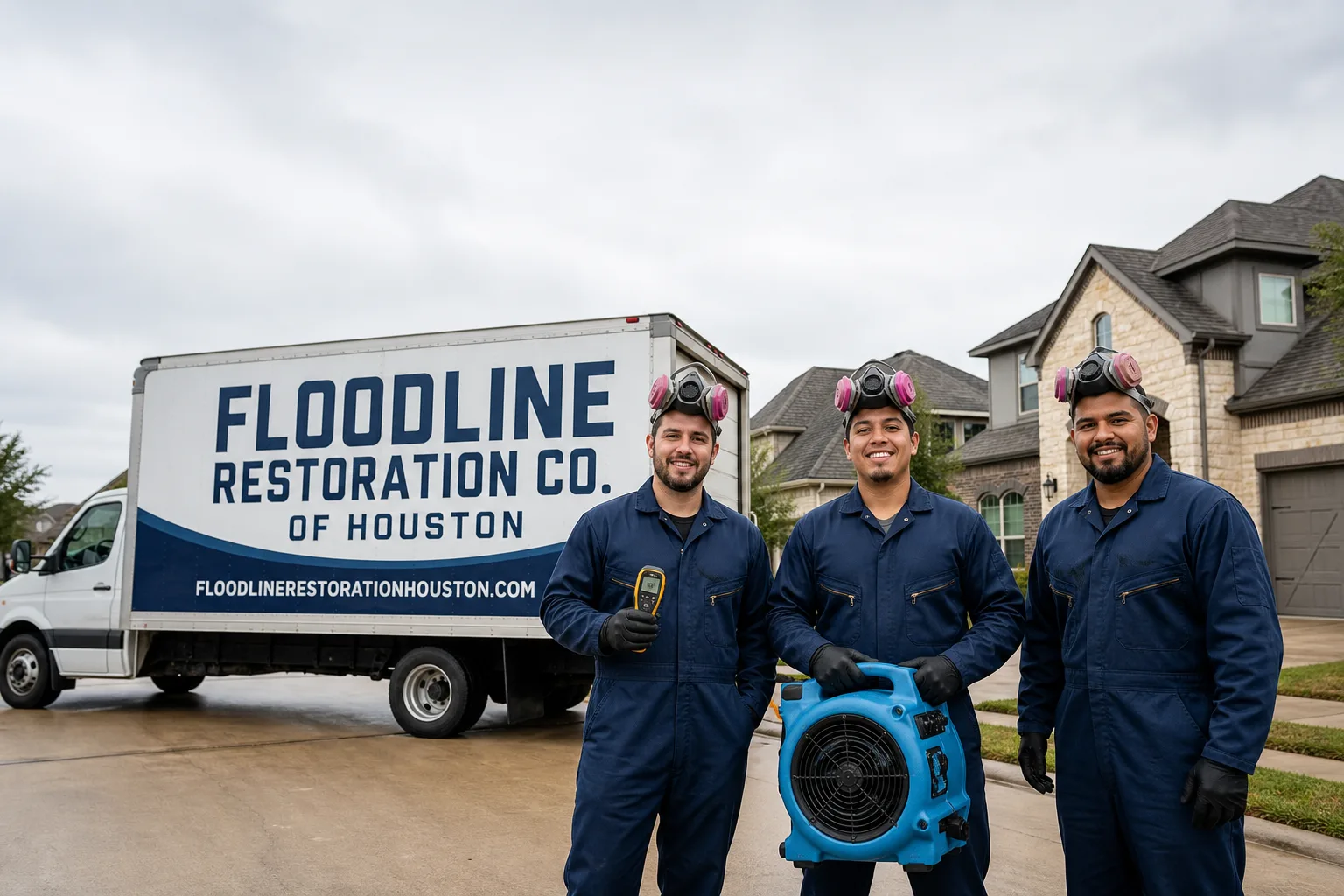
We also carry a written guarantee that no other restoration company in Pasadena offers with the same directness: the 90-Day Done Right Promise, our Keystone Standard. If the job isn’t done right, we make it right. No paperwork battles, no arguing. That matters to the homeowners we serve here, people who’ve lived in their houses twenty years and don’t want to re-litigate a restoration job six months after the storm. Our technicians are background-checked, uniformed, and certified to IICRC, RIA, and IFA standards. They drive clearly marked trucks and they carry moisture meters, not sales decks. Most importantly, when a homeowner in Pasadena calls at 2 a.m. because water is rising, a real person answers. Not a recording. A dispatcher who knows where Red Bluff Road is and which crew is closest.
We’re proud to serve local communities and have been restoring Pasadena homes since our founding, built around a dispatch board, not a sales desk. That structure shows up in how we work: one certified crew stays on your job from the first extraction through the final drywall patch and paint. No mid-job handoff to an unknown subcontractor, no playing messenger between our field lead and your carrier.
Our Storm & Disaster Restoration Services in Pasadena
Storm Damage Cleanup
After a Pasadena squall line or hurricane outer band, we handle structural debris, downed tree limbs against siding, wind-driven water intrusion, and saturated drywall. Pasadena’s 1950s and 1960s housing stock absorbs storm water deep into wall framing, so our cleanup protocol includes cutting access points where moisture hides, not just where pooling is visible. From 77505 near Pansy Park to 77508 along the eastern channel fringe, we clean and dry the full envelope of the damage.
Flood Damage Restoration
Floodwater in Pasadena is rarely clean water. Vince Bayou and its tributaries feed directly into the Houston Ship Channel, and when those waterways overtop, the resulting floodwater carries sediment, sewage, and industrial runoff from refineries and chemical plants. Before we begin Category 3 extraction in a Pasadena home, we assess whether chemical screening and air-quality testing are needed. Our restoration process accounts for that contamination, from disposal of saturated insulation to sealing wall cavities that absorbed petroleum-tainted water. The line the water left is where we start.
Emergency Board-Up
A broken window off Shaver Street or a compromised entry door after a storm is an open invitation, and not just for weather. Pasadena’s tight-lot neighborhoods mean a damaged home is highly visible from the street. Our emergency board-up crews arrive quickly, secure all openings with measured, clean plywood, and photograph every step for your insurance file. We’re often on-site within hours of the storm event, and same-day board-up service is common for homes in ZIP codes 77506 and 77507.
Roof Tarping
Wind damage along Pasadena’s tree-lined streets like Burke Road and South Houston-adjacent blocks frequently leaves exposed roof decking. A proper tarp job here requires more than a blue sheet and a few nails. Our crews use reinforced poly tarps, battens, and edge fastening that hold up to Gulf Coast wind. We tarp the damaged section, document everything for your carrier, and coordinate directly with your adjuster so the eventual roofer gets a clean scope.
What happens when you call
- 1
A real person answersNo phone trees - you reach a local pro.
- 2
You get an upfront price rangeHonest numbers before anyone is dispatched.
- 3
A background-checked tech heads outLicensed & insured, dispatched right away.
- 4
You approve before work beginsNothing starts until you say go.
Common Storm & Disaster Restoration Problems We See in Pasadena Homes
- Petrochemical-tinged drywall that never gets tested. Contractors who don’t know Pasadena’s Ship Channel context treat saturated drywall as ordinary flood damage. Our crews regularly detect petroleum or solvent odors during demolition in 77506 and east side homes, and we pause work to test before anyone spends more time in the space.
- Hidden moisture under pier-and-beam homes. Pasadena’s dense 1950s and 1970s tract housing sits on pier-and-beam floors that wick bayou water deep into subfloor cavities. The visible carpet dries, but the framing underneath doesn’t. That’s why our standard flood restoration here includes a subfloor inspection with cavity drying, not just surface extraction.
- Post-Harvey remediation that never went deep enough. After 2017, thousands of Pasadena homes were dried fast and patched faster. The result is latent mold behind walls and under baseboards that resurfaces after every fresh storm event. We find these hidden colonies by cutting inspection ports in lower wall sections and using B-Air equipment to run a containment dry-down that actually reaches the affected layers.
- Asbestos-containing materials complicating demolition. Pasadena’s older housing stock frequently contains asbestos-laden floor tile and insulation. When storm damage forces demolition, cutting into those materials without testing can release fibers and trigger regulatory problems. Our Storm & Disaster Restoration protocols include suspect-material sampling before any destructive work begins.
Pricing for Storm & Disaster Restoration in Pasadena, TX
We Also Serve Cities Near Pasadena
Our crews working in Pasadena also cover the surrounding communities with the same 24/7 live dispatch and the same 90-Day Done Right Promise. That includes Deer Park, South Houston, Webster, and La Porte. If you’re in one of those cities and storm damage hits, call the same number and a Pasadena-area dispatcher will route the closest certified crew to you.
Serving Pasadena, TX - Our Local Coverage Area
We’re based in the Pasadena area and know this community well. Use the map below to see our service coverage - if you’re nearby, we can almost certainly help.
FAQs - Storm & Disaster Restoration in Pasadena
How does being in the Houston Ship Channel petrochemical corridor change the assessment of flood water in my Pasadena home?
Floodwater in Pasadena must be assessed for chemical and petroleum contamination before any standard Category 3 restoration work begins, because the corridor’s refinery and tank-farm runoff often migrates into residential flood zones. Our teams look for telltale odors, surface sheen, and sediment staining, then order volatile organic compound screening and, when indicated, bring in an industrial hygienist to establish a safe work plan. Call (888) 977-4690 if you suspect the water in your home carried anything industrial, and we’ll start the assessment on our first visit.
I smell a petroleum-like odor inside my walls after the last storm. What does that mean for restoration in Pasadena?
A petroleum or diesel-like odor in saturated drywall or insulation is a strong sign that floodwater from the Ship Channel fringe or a nearby tank farm outfall migrated into your wall cavities. In Pasadena, that changes the restoration sequence: we halt demolition, seal the workspace with containment, run negative-air filtration, and bring in testing before structural drying continues. This is not something most restoration companies in surrounding suburbs will flag, and it’s precisely the kind of hidden hazard our Pasadena-specific crews are trained to catch. Call us and describe the smell; we’ll tell you over the phone whether immediate containment makes sense.
Why do pier-and-beam homes in Pasadena’s older neighborhoods need special attention after a bayou flood?
Pier-and-beam construction in Pasadena’s 1950s to 1970s tract homes leaves a crawlspace and subfloor framing that wick floodwater upward long after surface flooring looks dry. Moisture hides in floor joists, rim boards, and under-floor insulation, and it often resurfaces months later as mold or structural warping. Our restoration process includes subfloor cavity inspection, Injectidry panel placement for targeted drying, and moisture readings logged daily until the dry standard is met. If a previous contractor only extracted carpet and ran fans, the under-floor problem likely remains.
What hidden problems are common after Hurricane Harvey-era remediation in Pasadena housing stock?
The biggest hidden problem is mold that was sealed behind walls during rushed post-Harvey remediation. Many Pasadena homes were dried and closed up before wall cavities reached the proper dry standard, leaving latent colonies that reactivate with every new moisture event. We regularly open walls in Pasadena’s older neighborhoods and find mold growth that predates the current storm. Our protocol includes inspection ports in lower wall sections, moisture-mapped drying with professional-grade Dri-Eaz equipment, and documentation that gives your carrier a clear picture of what’s old damage versus new.
Do Pasadena flood damage jobs require different containment or air filtration than regular water damage?
Yes. Pasadena flood damage jobs in the northern ZIP codes and near the eastern Ship Channel fringe often require negative-air containment and HEPA filtration during demolition, because cutting into contaminated drywall releases particulates and volatile organic compounds that a standard water-damage job wouldn’t produce. Our crews use professional-grade B-Air equipment to maintain negative pressure, seal workspaces with poly containment, and run air quality checks before occupants re-enter. This is standard operating procedure for Floodline on Pasadena jobs, not an upsell.
Call Floodline Restoration Co. of Houston for Storm & Disaster Restoration in Pasadena
When the water recedes or the wind dies down, the work begins. The faster a certified crew gets into your Pasadena home, the less damage spreads and the fewer surprises wait behind your walls. We answer the phone with a live dispatcher around the clock, we send background-checked, uniformed technicians in clearly marked trucks, and we back every job with the 90-Day Done Right Promise. The estimate is free, the scope is written before work starts, and we bill your carrier directly. Call (888) 977-4690 now.
Written by Curt Bowman, Owner at Floodline Restoration Co. of Houston, serving Pasadena and the surrounding Harris County communities.